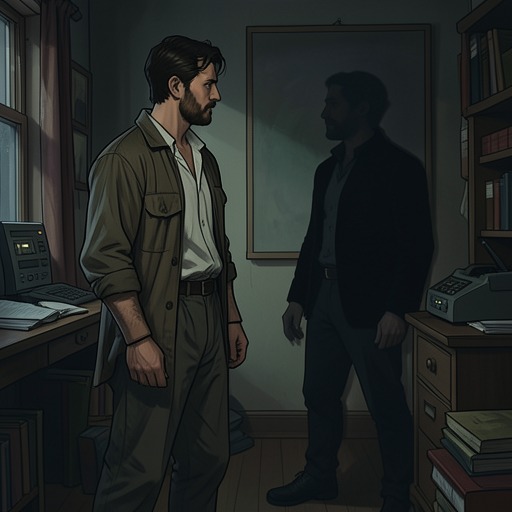
Petro’s grenade
Grey BeesPetro’s grenade is an R.G.D.-5 that Petro gives to Sergey Sergeyich when he leaves the beekeeper’s home. Offered as a gift for self-defence, it becomes more than a practical weapon: after Sergeyich loses track of it, the grenade embodies how wartime danger can enter the home, remain there without a clear place or purpose, and make a man feel unprotected even when he has been given the means to defend himself.
The Gift and Its Circumstances
Petro presents the grenade as he is preparing to go. He removes his rifle from the chair, slings it over his shoulder, and takes the R.G.D.-5 from the pocket of his warm camouflage jacket. Setting it beside Sergeyich’s teacup, he explains that it would not feel right to arrive at someone’s house without a gift. The placement makes an explosive weapon part of an ordinary exchange of hospitality, alongside tea and the honey Petro has been eating.
Sergeyich does not immediately understand why he should need the grenade. Petro answers that it is for self-defence and suggests that, if it remains unused, Sergeyich can bury it in his garden after the war. His offer makes the object’s double nature explicit: it is a possible safeguard in the present and something that ought to be removed from everyday life when fighting ends. The garden, associated with domestic space, becomes the proposed final resting place for a weapon brought into that space by war.
The gift is not isolated from the practical assistance that passes between the two men. Petro also offers to charge Sergeyich’s mobile phone using the soldiers’ generator, which can power even a washing machine. Sergeyich hands over the phone and charger, and Petro puts them in his jacket pocket before taking another spoonful of honey. The contrast is pointed: useful technology can be taken away to be charged, while the grenade stays with the civilian host, a form of help whose usefulness depends on the danger that makes it necessary.
Loss and Unease
After the visit, Sergeyich cannot account for the grenade. When a bee-pollen remedy seems to clear his head, his first distinct thought is to wonder where it is. He searches the sideboard drawers, the room, the space beneath his pillow, and even the coal buckets, but does not find it. He then remembers going out into the yard at night. The search turns Petro’s gift from a thing with a declared purpose into an unresolved presence: Sergeyich knows it was left for him, but cannot locate it or be certain where he has put it.
The next stage of the search follows Sergeyich’s tracks through the snowy yard. They lead towards the shed where the bees are wintering, the garage, and even the front gate. The evidence does not establish where he hid the grenade. Instead, the tracks show how far the uncertainty has spread across his property: the possible locations include work, shelter, and the boundary between home and the outside world. As he checks the shed and garage, his headache begins to subside, but the question of the grenade remains.
A Defence That Does Not Feel Like Safety
The grenade resurfaces in Sergeyich’s thoughts when he imagines encountering a sniper on the way to his position. He considers what he could say or ask of a man carrying a sniper rifle, then thinks of his own capacity to defend himself. The grenade might have offered an answer, but he cannot remember where he hid it while drunk. He concludes that he has nothing with which to protect himself, and distress sends him hurrying home.
That fear makes the gift’s intended reassurance unstable. Petro gives the grenade so that Sergeyich can defend himself; its disappearance instead leaves him confronting the possibility of armed violence without knowing whether the means of defence is within reach. The object’s significance lies not in an established use—the evidence does not show Sergeyich throwing it or otherwise deploying it—but in this gap between having been armed and feeling defenseless.
Narrative Significance
Petro’s grenade brings the war’s material reality into a household through the familiar language of a present. The soldier’s respect for his host and his concern about self-defence coexist in the same gesture; so do the tea-table setting and the explosive object. The grenade is therefore not simply a symbol detached from action: Sergeyich must search for it, trace his own movements, and later reckon with not knowing where it is while imagining a sniper nearby.
Petro’s suggestion that the grenade can be buried in the garden after the war offers a conditional image of a return to ordinary life. Yet the subsequent search prevents the object from remaining neatly contained by that future. It is already somewhere in Sergeyich’s surroundings, while the war still shapes what he fears and what he believes he needs. The gift’s unresolved whereabouts preserve that tension between domestic refuge and the violence that has entered it.